Running for shape – How to start running and do it right?
It has a positive effect on health, improves wellbeing and reduces stress. Running is practised by one in four physically active Poles, which makes it almost a national sport. However, although it seems to be a seemingly easy discipline, it can cause overload and injuries if we do not take care of proper preparation and training plan. – Before we start running, we must learn to walk properly – expert says.
Today even six million of us can be considered runners. As the MultiSport Index 2022 report shows, 65% of Poles are physically active and one in four of them ran in the six months preceding the survey.[1] This is good news because running has proven positive effects on health. According to a report published in the Journal of the American College of Cardiology, five minutes of running a day has a positive effect on life expectancy.[2] A study by scientists shows that running 1 to 2.5 hours a week can extend life by 6.2 years for men and 5.6 years for women.[3] In addition, jogging improves our wellbeing, has anti-stress properties, helps overcome our weaknesses and gives us the opportunity to compete in a healthy way. Moreover, starting the adventure with running does not require large costs. The low entry threshold is a huge advantage. It seems that buying shoes and putting on casual clothes is enough. It is indeed but only to quickly get discouraged or get injured because the above-mentioned advantage turns out to be a trap at the same time.
Runners’ cardinal sins
The most common mistakes of running enthusiasts – not only beginners but also advanced ones – include skipping the warm-up, lack of supplementary exercises (functional, strength, stabilisation), giving up stretching and inadequate regeneration.
And the list does not end there. It also includes too long and intense workouts, the lack of specific training plans, ignoring pain and signs of seemingly harmless injuries, etc. The effect?
A common injury among runners is the knee joint injury, due to its location between the hip, ankle joint and the foot, which is the first recipient of the ground. In addition, runners’ common nightmares are muscular system injuries caused by poor strength preparation. Therefore, an important element of any training programme is to structure it in such a way that it includes appropriate strengthening exercises that will prevent or minimise the likelihood of an injury – says Krzysztof Łyp, physiotherapist and motor preparation trainer at the Zdrofit Academy.
Runner’s training is not just about running
In other words: if you want to record regular progress you need to supplement running with a well-chosen training system. This means that you should invest not only in appropriate footwear and clothing but also in additional time for exercises, including workouts with training equipment that will properly prepare the body for the activity and protect us against the above-mentioned overloads and injuries.
Your strength base and awareness of your body in space are as important as going the next kilometres. Appropriate preparation and consistency allow us to overcome further barriers. Without an appropriate training stimulus, we will not jump over the limits imposed by our own body. By acting on the principle of programmed training, we will be able to reduce the likelihood of an injury, and thus constantly pursue our passion for running – suggests Krzysztof Łyp.
What should such training look like?
At the beginning there should be a 10-15 minute warm-up. You can use a medicine ball or make total jumps. At this stage, it is about activating the whole body with elements of dynamic stretching. This will allow you to focus on the ischiocrural muscle group and the buttocks, not forgetting the function of the spine and individual joints in the running sequence. In the final phase of the warm-up, it is worth using plyometric exercises –stretching and tightening of the muscles – which allows the nervous system to be better prepared for exercise. These include pogo jumps (we do them by placing our feet hip-width apart and jumping about 70% of our capabilities, landing quietly on straightened legs, freezing for a moment, and jumping again) interspersed with a jump rope or two-footed and one-legged landing exercises.
In the main part of the training, in the starting phase, it is worth focusing on a relatively small load with an average number of repetitions and playing with pace. You can use pace work, pauses in critical phases of movement, dynamic exercises, and unilateral exercises – says Krzysztof Łyp. – To feel good in the various phases of the run, it is also worth focusing on one-legged work in various sequences of movement. As your advancement progresses, you can introduce exercises on an unstable surface – he adds.
The effects rest on rest
After training, one must not forget about a very important issue, which is regeneration. This is a key part of any physical preparation to avoid injury. How long should it last? It often depends on the individual case, the length of the last training session, the age of the runner and the experience. Usually, one to three days is enough for tendons to recover, for example. Only marathon runners can – and even should – plan three to four weeks of rest after crossing the finish line of the “royal distance.”
No matter what your training goals are, a runner’s body needs adequate rest. Only a well-rested body can undertake further physical exertion, making the exercises more efficient – sums up Krzysztof Łyp.
What’s going on with walking?
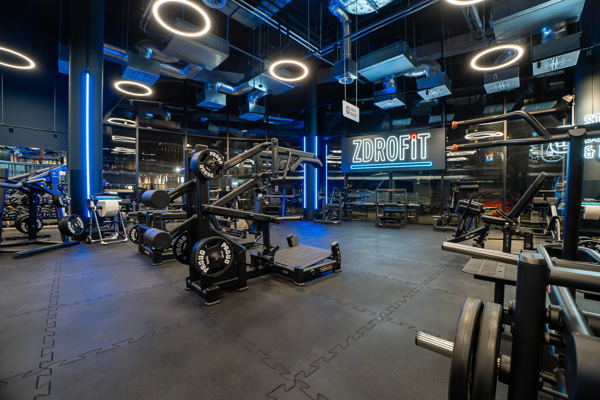
Such a training programme – possible under the supervision of a specialist at the club – will ensure that the runner’s adventure with this discipline will not end at the introductory level. One does not have to look far for support in this area as more and more fitness clubs are now offering this type of specialised exercise programmes. They can already be found, for example, in Zdrofit clubs in Warsaw, Legionowo, Tricity, Kielce or Koszalin, FitFabric clubs in the Łódź Province or in the Fitness Academy network in Wrocław or My Fitness Place in Kraków. They will also allow you to focus on a specific result goal and go beyond jogging with only health benefits in mind (which often has the opposite effect, causing you to stop training).[5] On the other hand, it will allow you to remember how much depends on focusing not on records but on the appropriate technique in the first phase of training.Exactly: technique. Before anyone starts an adventure with running, they should find out if they can... walk properly. For this, it will be useful to know the gait pattern as a basis for understanding what to focus on during the runner’s training.
When starting to run, it is worth looking at how our motor system behaves. The stance phase is 60% of the gait cycle. It includes heel-to-ground contact, eccentric braking, full foot loading and foot roll. The remaining 40% is the transfer phase. It is about rebound, acceleration, proper transfer, and braking. As for the running pattern, it is characterised by the fact that there is no double support phase. In short, it consists of the stance phase – shock absorption and rebound, rear and front, the flight phase, meaning ascending and descending, and the swing phase, both rear and front – explains Krzysztof Łyp.
Sounds complicated? Maybe a little. And it is because running is a bit more difficult than it may seem. When planning training sessions, it is worth consulting a qualified trainer who will translate the theory of gait into the language of practice and develop a programme that will allow the runner to go a long way in good health.
[1] MultiSport Index 2022 [2] MultiSport Index 2020: https://biuroprasowe.benefitsystems.pl/186355-badanie-multisport-index-2022-aktywnosc-fizyczna-polakow-po-dwoch-latach-pandemii [3] www.hss.edu/newsroom_run-your-way-longer-life-study.asp [4] Z. Waśkowski, Bieganie jako forma aktywnego spędzania czasu przez kobiety – motywy, preferencje i oczekiwania, „Marketing i Rynek” 11/2014, s. 483. [5] M. Grabus, M. Szymański, Społeczno-ekonomiczny wymiar biegania amatorskiego w Polsce, https://www.ssw-sopot.pl/wp-content/uploads/2018/12/8.-Spo%C5%82eczno-ekonomiczny-wymiar-biegania-amatorskiego-w-Polsce.pdf, dostęp: 06.05.2022.