Climbing – a sport that exercises both body and mind
Kraków is sometimes referred to as the climbing capital of Poland. On one hand, it offers access to an extensive network of indoor facilities, while on the other, it is situated close to natural climbing areas – most notably the Kraków-Częstochowa Upland. Partly because of international competitions, the popularity of climbing is growing, not only in the context of rock climbing, but also in forms focused exclusively on artificial walls. As a result, climbing walls bring together enthusiasts of various forms of the sport – people who enjoy being active in the company of others, such as groups of friends and families with children, as well as those seeking a workout for both body and mind.
Expanding the scope of climbing – from natural rock faces to indoor facilities – is considered one of the milestones in the popularisation of this discipline. Another one of these was the Olympic debut of speed climbing in 2021. Four years later, at the Paris Games, Aleksandra Mirosław won a gold medal, and Aleksandra Kałucka secured a bronze. Their quest for an Olympic podium was followed by an average of over a million viewers on Polish television, giving the channel a nearly 20 percent share of all people watching television in Poland at that time.1
It was also in Paris that the Olympic combined climbing competition was held for the first time. This is a competition that combines two disciplines: bouldering and lead climbing. The first of these – bouldering – involves climbing designated routes that are close to the ground. Climbers do not use a rope. If they fall off the wall, they land on special mats known as crash pads. In bouldering, the challenge is not the height, but the demanding route itself. To complete it, one first needs to devise the right movement patterns, and then possess the skill to execute them. Lead climbing, on the other hand, involves completing a route set on a 15-meter wall as quickly as possible. Climbers use a climbing rope, clipping it into so-called quickdraws (protection points). Each day, the stands at this event easily drew a capacity crowd. At the 2028 Games, climbing will be represented across three separate events. All these spectacular competitions take place on artificial walls. It is therefore no surprise that there is a growing group of so-called “gym climbers” – people who specialise exclusively in climbing indoors.
Climbing is becoming more accessible to people not just through the ability to follow competitions. Almost anyone who decides to try their hand at a climbing wall can reach the so-called “top” (the final hold on a climbing route). This is especially true since Kraków has an extensive base of climbing facilities, offering routes for both beginners and experienced competitors.2 It is within the facility that you can discover, in comfortable conditions, how you feel about a new type of activity.
Low barrier to entry
You don’t need to specifically build up your fitness, strengthen your arms, or improve your physical condition before the first visit. Naturally, good physical fitness – developed also through the practice of other sports – can be an additional asset. However, it is not a fundamental prerequisite for beginning one’s climbing journey. The facilities offer routes with a wide range of difficulty levels, from those that, according to Denis Kirus, a climber and climbing instructor with many years of experience, might even be easier than climbing a ladder, to highly demanding routes designed for advanced climbers.
Denis Kirus also does not see a rigid age barrier. As he emphasises, one can start at any age, whether it’s a child with whom one can already communicate easily, or someone over fifty who has had little to do with sports in recent years. However, the support of a qualified instructor is crucial as they will tailor the difficulty level to the participant’s age, capabilities, and physical condition, ensure proper technique, and provide the necessary spotting and safety measures during those first attempts on the climbing wall. The beginning often brings a great deal of satisfaction. The body adapts quickly to new movements, technique and finger strength improve, and a route that proved impossible during the first session may well become a warm-up after a few more visits. Over time, the way in which one traverses the path ahead gains increasing significance.
– Climbing combines strength, endurance, and a great many technical elements. On top of that, there is one of the most important aspects – the mental one. Many people struggle with a fear of heights or of falling. It is worth remembering, however, that climbing walls are equipped with appropriate safety measures. Depending on the type of climbing, these may include belay systems or special mats designed to cushion falls. In addition, beginners can count on the support of instructors, coaches, or operators. You don’t have to conquer the highest walls right away. Everyone can progress at their own pace and according to their own capabilities. For me, it is precisely the combination of physical and mental challenges, along with the satisfaction of overcoming one’s own limitations, that makes this sport especially beautiful – says Denis Kirus.
Climbing ranks fourth among the most popular activities for MultiSport users in Kraków, who, with their sports card, have access to 13 facilities that feature artificial walls.
Children don’t yet know that “it can’t be done”
– Climbing is a particularly rewarding activity for children, as each route requires a slightly different way of moving. You must decide where to place your foot, how to position your body, and from which side to reach for the next hold. An adult is more likely to try to make use of movement patterns they are already familiar with. A child does not make such a sharp distinction between what is familiar and what is not, which is why they are more inclined to experiment. Climbing therefore develops not only strength, coordination, and balance, but also teaches that if one approach doesn’t work, you can look for another. Children learn how to solve problems more quickly. Learning different movements comes much more easily to them than it does to adults – says Denis Kirus, who also regularly conducts classes for children and young people.
A workout for the body and a puzzle for the mind
Finding new ways to climb up can also prove to be captivating and enriching for adults.
– Training ceases to be merely a matter of muscular effort and physical conditioning; it also becomes a mental puzzle. During an attempt, the focus is on the next hold, body position, and how to solve the upcoming sequence. Reaching the top provides a very concrete goal, as well as the satisfaction that comes from achieving it – adds Denis Kirus.
Regardless of the chosen type of climbing, a beginner must learn to use their body in a somewhat different way. Rope climbing adds to this the challenges of working at height, managing belay systems, confronting one’s own concerns (including fear), and developing tactics for completing a route. Bouldering focuses more on how to use one’s body to complete a short, often highly technical route. In both cases, you need to be focused on what is happening here and now.
– To begin with, it is therefore worth choosing a place where you can try out various options under the guidance of an instructor, coach, or operator. The instructor explains safety rules, selects an appropriate route, and allows us to see how we react to heights. Equipment such as climbing shoes, a harness, and a rope can usually be rented on-site – emphasises Denis Kirus.
A meeting on the wall
Modern climbing wall facilities serve many more functions than just providing space for climbing. Training requires a warm-up, mobility, strength, and recovery. That is why, alongside the climbing walls, there are areas for exercise, stretching, or strength training. Good physical fitness aids progress in climbing, and for more advanced climbers, gym training can become a natural complement to their practice. Among MultiSport users, combining gym workouts with rock climbing is a popular pairing of activities.
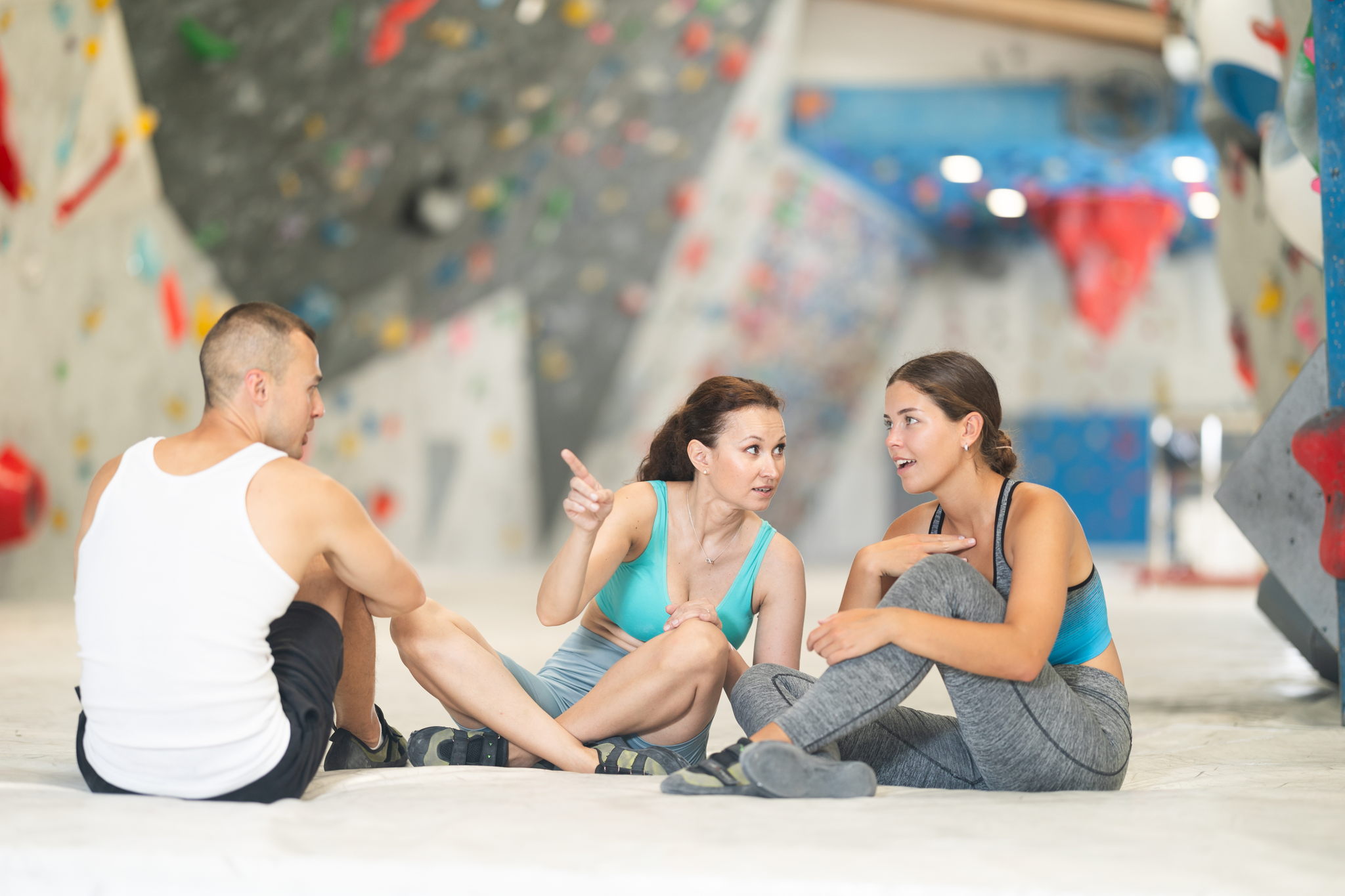
The social aspect of climbing is equally important. Training sessions are interspersed with rest, observing others, and conversation. For this reason, some facilities also offer cafés and spaces where people can spend time before, during, or after their workout.
– Climbing is a very social sport. You can come alone and work on your climbing challenge, but you can just as easily do so together with others. On the wall, people talk about routes, suggest solutions to one another, and observe others. For me, the social aspect of climbing is very important – admits Denis Kirus.
This aspect aligns well with the findings of the MultiSport Index 2025. Support from another person is most frequently mentioned as a factor that can encourage us to engage in physical activity.
Autumn is a good time for indoor training
According to data from the MultiSport Programme, the current autumn-winter season is a time of increased physical activity in indoor facilities, including that related to climbing walls. If, over time, you feel the urge to test your skills on real rock, one of the most obvious destinations is the Kraków-Częstochowa Upland. The wspinanie.pl database lists over 7,000 climbable routes in that area, with the Rzędkowice Rocks alone offering nearly 300 of them.
– There is no specific level that one is required to reach before their first trip. The better we perform on the climbing wall, the easier it will be on real rock but there’s no need to wait years before your first outdoor trip. However, it is worth going with an instructor or with experienced climbers. In a natural environment, there are additional procedures and equipment-related tasks that aren't performed during standard training at a facility – advises Denis Kirus.
You don’t need to know right away what kind of climber you want to become. To start, simply choose the first route and try to reach one hold higher.
1 https://centruminformacji.tvp.pl/79711151/az-38-mln-widzow-ogladalo-historyczna-wygrana-polskich-siatkarzy-z-reprezentacja-usa-grupa-tvp-liderem-tvp2-na-czele-anten
2 https://krakowportal.pl/scianki-wspinaczkowe-w-krakowie-gdzie-zaczac-i-gdzie-trenowac-na-wyzszym-poziomie/

Barbara Jastrzębska
For over 20 years, Benefit Systems has been the leader of the Polish employee benefits market and one of the key players in the region’s fitness industry. The company’s flagship product is the iconic MultiSport Programme providing access to thousands of sports and recreational facilities. The portfolio is complemented by the MyBenefit cafeteria platform and the Multi.Life wellbeing programme, creating a benefits ecosystem for companies that care about their employees. The group operates in six markets. In addition to Poland, its sports offering is available in the Czech Republic, Slovakia, Bulgaria, Croatia, and Turkey. Benefit Systems is also the largest fitness club operator in Poland, managing nearly 300 clubs, mostly those under the Zdrofit brand. The mission of Benefit Systems is to inspire physical activity and promote health at every stage of life. The company conducts educational and health-oriented initiatives for children, adults, and seniors, including through the MultiSport Foundation. Since 2018, it has been part of the B Corp community, which brings together companies committed to the highest standards of social responsibility and engagement. More information at: https://www.benefitsystems.pl/en and https://biuroprasowe.benefitsystems.pl/en.


