From 3 June helmets on bicycles and electric scooters are mandatory. How to teach children safety rules?
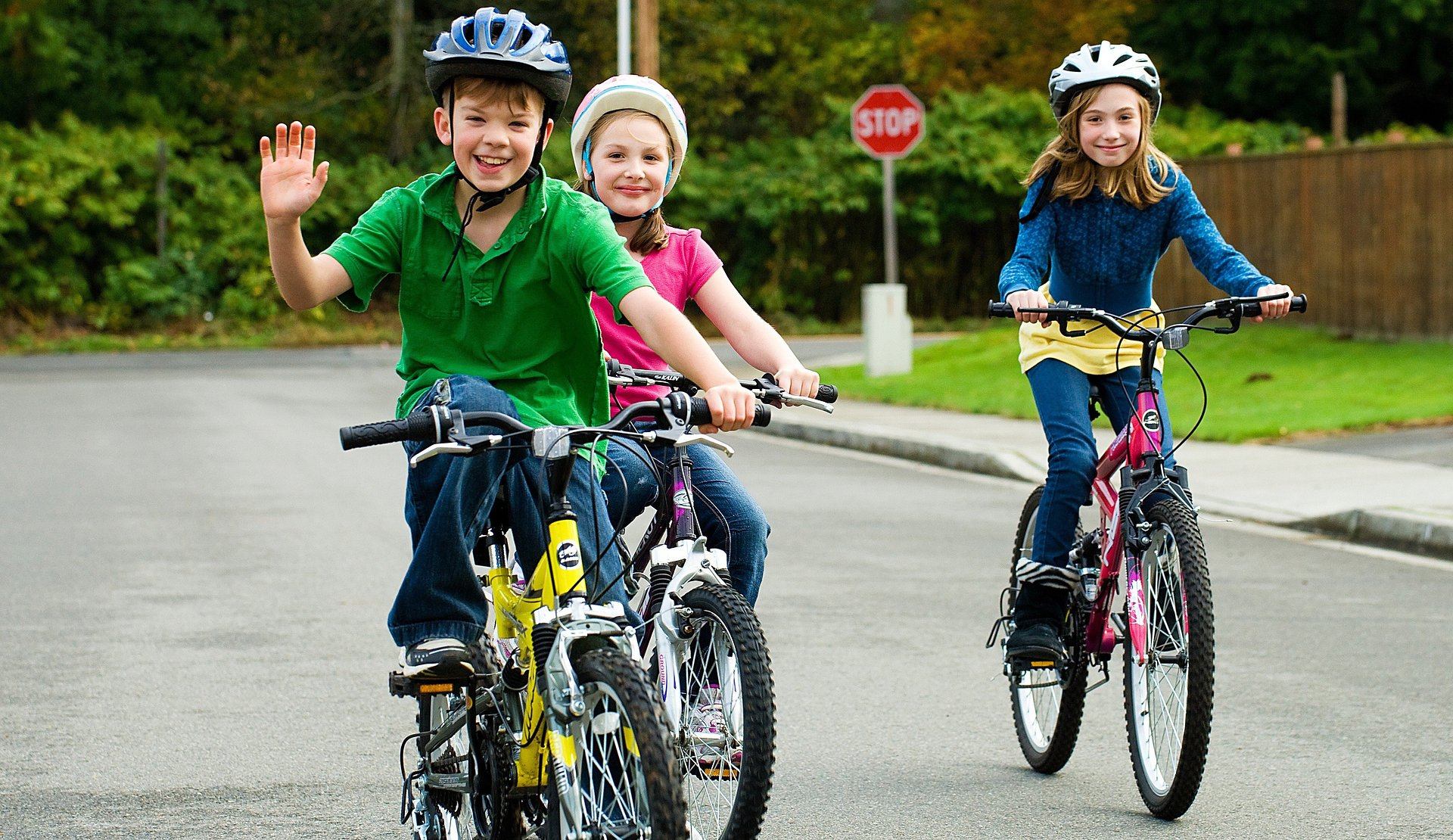
From 3 June this year, children and young people up to 16 years of age will be required to wear helmets when riding bicycles, electric scooters and personal transport vehicles. Today, only half of children and teenagers riding them in Poland wear a helmet. Experts warn that regulations are only the first step towards improving safety. The key is conversation and learning to recognise dangers from an early age. How to effectively talk to children about safety?
According to the Police Headquarters data, last year, over 6,000 users of bicycles and electric scooters were involved in accidents. Nearly 1,100 children under 17 years of age were involved in road accidents as drivers. Some of these incidents were caused by underage cyclists (221 children aged 0–17) and electric scooter users (359 children aged 7–14 and 237 children aged 15–17).
– Situations in which we observe both children and adults cycling or riding electric scooters without helmets are common in Poland. Most accidents involving them occur during the summer holidays, which coincide with the implementation of the mandatory helmet law. Failure to wear a helmet for anyone under 16 can result in a fine of up to PLN 100 – points out Chief Inspector Emilia Kosma, an expert from the Social Prevention Department of the Prevention Bureau of the Police Headquarters. She adds that in March this year, regulations were introduced that prohibit the use of electric scooters by children under 13 years of age outside the residential area and without the supervision of an adult guardian.
The Ministry of Infrastructure points out that head injuries account for one third of all injuries to e-scooter users, and research confirms a direct link between riding without a helmet and traumatic brain injury. In turn, data from the European Trendline report co-financed by the European Union indicates that in Poland, only 51% of Polish cyclists under 14 years of age and only 23% of those over 15 years of age wear helmets. These are among the lowest figures in the European Union.
Helmet protects, knowledge saves
– The new law imposes an obligation but it does not create habits and does not teach the recognition of hazards, risk assessment or proper behaviour in road traffic. These are competences that cannot be decreed by law. We need proper education of children. Their guardians and teachers play a special role in this process – emphasises Chief Commissioner Emilia Kosma.
A survey conducted by the MultiSport Foundation shows that one in two adult Poles (57.5%) believes that primary schools should be more involved in building safety awareness among children.
– To support parents and teachers in building healthy habits among children and young people, we have created a free nationwide MultiBezpieczeństwo Programme. As part of the project, a special guide and ready-made lesson plans were created that teach safety rules in seven scenarios covering road traffic, urban space, as well as spending time by the water and at home. The programme is carried out under the patronage of the Education Development Centre, Volunteer Water Rescue Service (WOPR), the Police and the Chief Commander of the State Fire Service. So far, the educational materials have been distributed to 14,000 primary schools across the country, and over 650 teachers have used them – explains Justyna Rysiak, President of the MultiSport Foundation.
In terms of education about threats, the MultiBezpieczeństwo Programme helps schools meet the assumptions of the current core curriculum, focusing on modern teaching methods tailored to children’s abilities.
Safety is not a list of regulations
It’s a competence: to see more, to think faster and to act smarter.
– The topic of safety is very often enclosed within the tight framework of a list of prohibitions and warnings. In an effort to protect children, we unconsciously teach them to fear the world instead of understanding it and assessing risks. Directing a child’s every step can prove disastrous, because fear and coercion do not teach responsibility – says Ilona Gregorczyk, teacher, specialist in innovative teaching methods, and expert at the MultiSport Foundation. – A child should be able to recognise danger, analyse the situation and react appropriately. That is why it is so important to understand the process by which threats arise. We should thus explain to children why something can happen, what its consequences may be, and why it is dangerous. However, we should do it in a form appropriate for children. This is what distinguishes the MultiBezpieczeństwo method, in which children do not receive another lecture on obligations and prohibitions, but participate in multisensory education based on experience, movement, cooperation and analysis of real situations – she explains.
Ready-made lessons include suggestions for educational games, safe experiments, physical tasks and those engaging the senses. Thanks to exercises, children do not repeat rules, but apply them in practice and have the opportunity to draw conclusions.
– A child who simulates calling for help will react differently than one who has merely read the instructions. That is why the MultiBezpieczeństwo Programme is based on situational education and movement because safety rules cannot be memorised like multiplication tables. They must become a reflex – adds Ilona Gregorczyk.
Holiday dangers don’t end with two wheels
During the upcoming holidays, children have more time to be active and more space to be independent, but they are also exposed to more risks.
– It is worth taking care of the issue of water safety today. Although knowledge in this area is growing, we still undertake hundreds of interventions. Last year, from April to September, 200 people drowned in Poland, including 12 children – emphasises Paweł Błasiak, President of the Volunteer Water Rescue Service (WOPR).
– It is also worth paying attention to safety rules when a child or rather a teenager is alone at home. Improper operation of home electronics and use of the stove – these are situations that may contribute to the emergence of a hazard. It is also worth reminding children the rules of calling for help and practising with them – says Mariola Główka from the National Headquarters of the State Fire Service of Poland.
A survey conducted by the MultiSport Foundation shows that one in three adult Poles do not know the rules for providing help to children in an emergency.
– Teaching children safety rules can also be a good opportunity for parents to refresh and systematise their knowledge. This is especially true since the space we live in is changing faster than ever – new forms of activity, new threats, new regulations – emphasises Justyna Rysiak. She summarises: – The new regulations come into force in a few days. But child safety doesn’t start with a helmet. It starts with a conversation and knowledge that children can take with them on their bike, to the water, and back home. Parents often don’t know how to start and conduct such a conversation. Children are ready to learn this sooner than many might think.


Photos from the MultiBezpieczeństwo Programme demonstration lesson with the participation of the Police, Volunteer Water Rescue Service (WOPR) and the Fire Department on 26 May at the PGE Narodowy Stadium. PGE National materials.
Free guides and lessons are available at your fingertips, free of charge at: www.multibezpieczeństwo.pl.

Marcin Walendziak
About the MultiSport Foundation: The MultiSport Foundation implements educational and social projects promoting an active, healthy lifestyle among children, adults and seniors. The foundation operates within the Benefit Systems Group – the leader of the Polish non-financial benefits market and creator of the MultiSport Programme. More information at: fundacjamultisport.pl